
Quiet Cube generator soundproofing is a Manufacturer establishment in Johannesburg, Gauteng, South Africa
Quiet Cube: Custom sound attenuation enclosures for generators, compressors and water pumps in Gauteng
Quiet Cube operates as a Johannesburg-based manufacturer that designs and installs bespoke sound reduction enclosures for a range of noisy equipment, primarily generators, but also compressors and water pumps. The company programme centres on creating weatherproof, high‑quality boxes that minimise noise to comply with municipal limits while maintaining equipment performance.
The core offering covers both domestic and commercial needs. Domestic options include compact “Portabox” units intended for small 2–3 kW inverter generators, featuring quick‑release pull tabs for fast breakdown and assembly—an arrangement particularly suitable for campers and temporary deployments. For larger applications, a medium enclosure suits open‑frame generators up to 7.5 kVA, and a larger model accommodates closed‑frame “silent” generators from 5 kVA to 15 kVA. On the commercial side, Quiet Cube designs and fabricates custom cladding and attenuation solutions for generators ranging from 25–350 kVA, including bespoke solutions for industrial and residential complexes with strict noise requirements.
In addition to generator enclosures, Quiet Cube produces bespoke sound‑attenuation boxes for compressors and water pumps. These can be equipped with cooling fans as needed, and each unit is tailored to site conditions. A key service feature is a site‑visit approach within Gauteng, enabling the team to assess space, airflow needs and acoustic goals before crafting the enclosure for optimal performance.
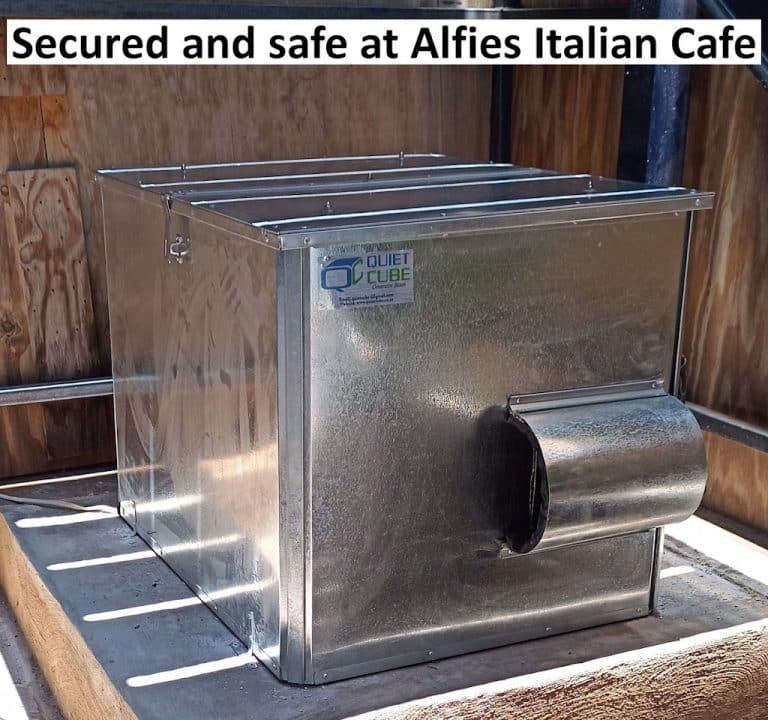
Constructed with a durable, weatherproof galvanised steel exterior, Quiet Cube enclosures integrate several practical design elements. High‑output 220 V axial fans aid cooling, while the boxes are designed for easy maintenance with corner pull tabs that allow fast disassembly for generator servicing. Internally, the units use high‑quality sound‑proofing wool encased in heat‑resistant cloth to achieve effective attenuation and a neat finish. Each box is custom fabricated to fit the client’s specific genset, ensuring fit‑for‑purpose performance and a tidy appearance on-site.
Customer experience across reviews highlights reliability and practical support. Clients report significant noise reductions—often enough to render the site generator barely noticeable to neighbours—and praise the build quality and ease of on‑site servicing. Several reviews mention responsive after‑sales assistance, with owners and the team providing ongoing support and backup as part of the service, which appears to extend beyond initial installation.
Typical projects span residential estates and larger complexes that demand strict noise compliance. Quiet Cube positions itself as a preferred supplier in some Midrand and Centurion estates, where regulatory noise limits are a key consideration for residents. The combination of custom engineering, durable construction and a focus on cooling efficiency helps ensure generators remain adequately cooled while operating within accepted decibel levels.
How requests typically work
- Consultation and site assessment in Gauteng to determine acoustic targets, enclosure size, ventilation needs and mounting considerations.
- Custom design and fabrication of the enclosure to match the client’s generator or equipment specifications.
- Installation and commissioning, followed by performance verification to ensure noise reductions meet municipal limits (commonly within 57–70 decibels, depending on the model and installation).
- On‑site accessibility features, such as easy disassembly for servicing, and maintenance support after installation.
Practical tips for customers
- Confirm the exact generator or equipment model, including open‑frame vs closed‑frame configurations, to ensure a precise enclosure fit.
- Discuss cooling requirements early; high‑output fans are integral to maintaining performance and preventing overheating.
- Ask about maintenance access, including the convenience of dismantling pull tabs for servicing and routine checks.
- Consider the enclosure’s location relative to boundaries and neighbour lines to optimise perceived noise reductions and comply with local by‑laws.
- Request information on the materials used, particularly the type of sound‑absorbing wool and heat‑resistant lining, to assess durability in exposed environments.
Location and service area
Quiet Cube operates within Gauteng, with site visits and installations available for customers across the province. The product range supports both domestic installations and larger commercial or industrial sites requiring robust noise attenuation measures, including residential estates and large complexes that demand compliance with noise limits.
Operating context
Reviews describe the product as effective and well‑made, with several customers noting substantial improvements in noise levels and generator cooling. The company’s emphasis on custom design, quality construction and supportive service is a recurring theme in customer feedback, underscoring a practical, no‑nonsense approach to reducing audible disruption from noisy equipment.
Johannesburg
Gauteng
South Africa


Sorry, no records were found. Please adjust your search criteria and try again.
Sorry, unable to load the Maps API.
Manufacturer Services in Johannesburg, Gauteng
In Johannesburg, Gauteng, the range of manufacturer services commonly centres on turning concepts into tangible products through a combination of mechanical work, fabrication, and value-added processes. Business customers seeking reliable execution often look for operations capable of handling both small runs and larger production demands, with a focus on efficiency, quality, and responsiveness within a dynamic urban economy.
Typical offerings include machining and fabrication that convert design drawings into finished components. This can cover precision turning and milling, CNC programming, and fabricating metal and non-metal parts. Sheet metal work is frequently provided, including cutting, bending, welding, and assembly of enclosures, housings, and structural components. When electrical or electronic elements are involved, integration and supplier coordination for cabling, harnesses, and boxed assemblies may also feature in the service portfolio.
Prototype and product development support is another common facet. Manufacturers in the region often collaborate with clients to refine concepts through rapid prototyping, small-batch testing, and iterative feedback cycles. This path helps to reduce risk before committing to larger production runs and may involve tolerancing, material testing, and feasibility assessments conducted in collaboration with the client’s engineering team.
Quality assurance and process control are emphasised to safeguard performance and compliance. Many operations implement standard measurement and inspection routines, document control for traceability, and systematic approaches to defect reduction. While specific certifications cannot be assumed, customers typically expect clear communication about lead times, material specifications, and acceptance criteria for accepted goods.
Equipment and capability commonly seen in Johannesburg’s manufacturing landscape include versatile machine tools, weldability for various metals, and assembly lines capable of stacking several discrete processes into a cohesive workflow. The ability to accommodate design changes, complex geometries, or customised finishes varies by facility, and discussions with prospective providers usually clarify the scope, available tooling, and capacity constraints.
Customers benefit from a practical emphasis on logistics and delivery. Johannesburg-based manufacturers frequently coordinate storage, scheduling, and transport within Gauteng and neighbouring provinces. Considerations such as lead times, batch sizes, packaging requirements, and risk management on transit are routinely addressed in the planning phase. For projects spanning multiple sites, seamless coordination between procurement, production, and distribution helps reduce downtime and delays.
Property and site considerations can influence service delivery. Industrial zones with access to freight facilities, road networks, and utility reliability offer advantages for manufacturing operations. Power reliability, water supply, and waste management are practical factors that organisations assess when selecting a partner. Compliance with local health and safety rules, site access controls, and environmental guidelines is commonly expected as part of responsible manufacturing practice.
For clients contemplating engagement, it is useful to review a provider’s track record regarding collaboration, clarity of quotations, and support after production. Early alignment on material choices, finish specifications, testing requirements, and documentation can help ensure that the finished goods meet the project’s functional and logistical needs. Ultimately, the objective is to realise durable components and assemblies through a blend of skilled workmanship, engineered processes, and dependable delivery in the Johannesburg region.
If this is your business, please click the button below to claim it.
By claiming the listing, you will be able to edit it, and add your own text, images, videos and business hours
Please use this listing as an advertisement for your business. It is provided for Free.