
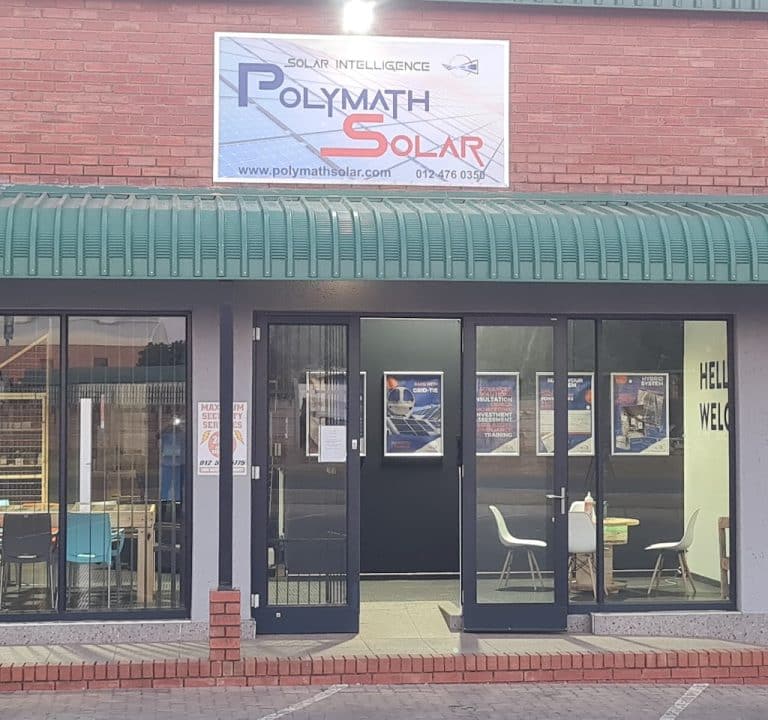
Polymath Solar (Pty) LTD is a Inverters and UPS, Solar energy company establishment in Pretoria, Gauteng, South Africa
Polymath Solar (Pty) LTD — Inverters and UPS, Pretoria
Polymath Solar (Pty) LTD operates as a Pretoria-based solar energy specialist focused on delivering robust energy management solutions that combine solar generation with intelligent storage and tariff optimisation. The company presents itself as more than a traditional solar installer, emphasising a data-driven approach to achieving grid independence and lower operating costs for business customers. Core capabilities align with the Inverters and UPS category by integrating battery storage, power conversion, and reliable backup capabilities within a single, optimised system.
The business promotes a holistic value proposition centred on “cash-positive solar + storage from Month 1,” underpinned by its Solar Intelligence technology. This platform is described as coordinating solar generation, battery storage, and real-time tariff management to secure the lowest-cost, most reliable power. Practical outcomes highlighted include immediate cashflow improvements, reduced peak demand penalties, and the ability to store cheaper energy for use during tariff peaks. The emphasis is on sustained performance, with modelling and live monitoring offered to back performance guarantees.
Typical services described fall into three interconnected strands:
- <strongSystem design and optimisation – data-driven, phase-by-phase roadmaps from grid reliance to energy autonomy, with detailed energy and power analyses, tariff studies, and load profiling to tailor the solution to a specific business site.
- <strongIntegrated turn-key installations – engineering, procurement and construction (EPC) capabilities that combine solar PV, battery storage, and power electronics to form a complete energy system suitable for commercial and industrial environments. Examples of project scale include large commercial offices, healthcare facilities, and industrial sites.
- <strongOngoing performance and compliance support – monitoring, performance modelling (PVGIS-based), and compliance with recognised standards and certifications (SAPVIA PV Greencard, SANS 10142-1, NRS097) to ensure long-term reliability and regulatory alignment.
Typical projects mentioned include high-profile installations associated with healthcare, automotive, logistics, and commercial office sectors. These case studies underscore the firm’s capability to handling complex, data-driven, multi-technology deployments such as grid-tied and hybrid systems, as well as upgrades to include battery storage and smart controller technology. A notable emphasis is placed on collaborative engagements with electrical and consulting engineering partners for large or technically demanding renewable energy projects.
Financing and incentives are presented as an enabling feature. Polymath Solar notes connections with major banks and third-party financiers, offering asset financing or conventional loans. Payback periods are framed within a broad range (from around two to eight years, depending on the chosen solution). Tax considerations highlighted include depreciation allowances applicable under the 12A framework, with an emphasis on leveraging financial instruments to maximise return on investment.
The company also highlights its credentials and process quality. Personnel qualifications span solar power technology training, design certification, and teaching roles at recognised training bodies, suggesting a strong emphasis on up-to-date expertise and knowledge transfer. Claims of extensive project experience are supported by statistics such as thousands of solar system designs and several hundred successful installations, along with substantial aggregate capacity across AC power, PV power, backup power, and battery storage.
For customers seeking a pragmatic approach to energy resilience, Polymath Solar offers a structured engagement workflow. Prospective clients typically undergo a comprehensive initial assessment, including tariff structure analysis and load profiling, followed by a decision-support phase using cost-benefit metrics such as real Levelised Cost of Energy (LCoE), Net Present Value (NPV), Internal Rate of Return (IRR), and simple payback. This framework aims to provide clear, financially grounded guidance on investment decisions.
Operational insight and customer tips:
- Prepare a clear description of current energy usage, peak periods, and any reliability concerns to help tailor the Solar Intelligence design.
- Request a preliminary energy audit or load profile study to understand potential savings and the expected ROI before committing to a full EPC project.
- Incorporate battery storage and intelligent tariff optimisation from the outset to maximise savings during peak tariff periods.
- Confirm project compliance with SAPVIA Greencard and relevant South African standards to ensure long-term serviceability and warranty alignment.
- Discuss available financing options and depreciation benefits with finance partners to optimise cashflow and return on investment.
Polymath Solar positions itself as a Pretoria-based partner for organisations aiming to reduce exposure to tariff volatility, unreliable infrastructure, and diesel costs, offering an end-to-end path to grid independence through Solar Intelligence, specialist engineering, and credible financial modelling.
Pretoria
Gauteng
South Africa


Sorry, no records were found. Please adjust your search criteria and try again.
Sorry, unable to load the Maps API.
Inverters and UPS Solutions for Pretoria, Gauteng
In Pretoria, Gauteng, businesses and households rely on resilient power systems to mitigate the impact of load shedding, grid fluctuations, and outages. Inverters and Uninterruptible Power Supply (UPS) solutions form the backbone of dependable energy management in this region. Providers typically offer a range of services designed to ensure continuity of operations, protect sensitive equipment, and optimise energy use across commercial, industrial, and residential settings.
Service offerings commonly associated with inverters and UPS in Pretoria include system design and consultation, installation, commissioning, and ongoing maintenance. A typical project begins with an assessment of power requirements, including critical loads, battery capacity, charging options, and available solar input if a hybrid arrangement is desired. Based on the assessment, a suitable inverter or UPS configuration is recommended. This may involve standalone inverters for off-grid compatibility, UPS units for immediate transfer during a blackout, or hybrid systems that combine solar generation with energy storage for daytime and post-sunset resilience.
Installation services cover the mounting, wiring, and integration of inverters, UPS devices, batteries, and related peripherals. Technicians ensure that electrical connections comply with local standards and safety practices, and that the system interfaces correctly with existing distribution boards and generators where applicable. In many cases, service providers also facilitate the integration of monitoring equipment that tracks performance metrics such as battery state of charge, inverter efficiency, and system uptime.
Commissioning marks the transition from a configured design to a tested, operational installation. During this phase, engineers verify fault protections, automatic transfer switching, and surge protection, ensuring seamless handover from the main grid to the backup power source. In addition, attention is given to harmonising charging cycles with available solar input, if present, and confirming that critical circuits maintain priority during disturbances.
Maintenance and support form a key component of the service landscape. Regular inspections, battery health testing, firmware updates, and performance tuning help sustain reliability over the system’s lifecycle. Maintenance plans may offer response times for fault detection, on-site visits, and remote monitoring access to alerts and trend analysis. Many providers also offer battery replacements or retrofits as technology and usage patterns evolve.
Practical considerations for customers include understanding load prioritisation, battery technology choices, and environmental conditions. Providers typically advise on the best-fit technologies for specific purposes—such as lead-acid, AGM, gel, or lithium-ion batteries—while weighing factors like cost, cycle life, charging speed, and space requirements. The choice of inverter or UPS capacity should align with peak load demands and desired autonomy duration, with a margin built in to cover unexpected surges or extended outages.
In Pretoria and the broader Gauteng region, ongoing maintenance plans may address the region’s climate and fuel diversity. For solar-enabled setups, careful attention is given to the arrangement of panels, the orientation and tilt appropriate to the local sun profile, and the efficiency of charging infrastructure. Providers may also advise on grid interaction rules, tariffs, and potential incentives related to solar energy storage, while ensuring compliance with safety and electrical standards.
Customers seeking inverter and UPS services can expect a structured approach: a clear assessment, technically sound design, compliant installation, rigorous commissioning, and reliable ongoing support. The overarching goal is to deliver a dependable, scalable solution that protects essential operations, improves energy resilience, and optimises overall power management in Pretoria’s dynamic electrical environment.
If this is your business, please click the button below to claim it.
By claiming the listing, you will be able to edit it, and add your own text, images, videos and business hours
Please use this listing as an advertisement for your business. It is provided for Free.